Llgaay Gwii sdiihlda (Restoring Balance project) 2014-2019
The suggested citation for this analytic appendix is:
Thorley, J.L. & Irvine, R.L. (2024) Llgaay Gwii sdiihlda (Restoring Balance project) 2014-2019. A Poisson Consulting Analytic Appendix. URL: https://www.poissonconsulting.ca/f/994043377.
An associated paper is available from publications.
Background
To restore balance, a deer removal program was implemented on various islands in Gwaii Haanas.
The primary goal of the current analyses is to answer the following questions:
What was the relative efficiency of the removal methods?
What would the cost of removing the remaining deer have been?
Data Preparation
The data were provided by Parks Canada in the form of Excel spreadsheets and prepared for analysis using R version 4.3.2 (R Core Team 2020).
Statistical Analysis
Model parameters were estimated using Bayesian methods. The estimates were produced using JAGS (Plummer 2003). For additional information on Bayesian estimation the reader is referred to McElreath (2020).
Unless stated otherwise, the Bayesian analyses used weakly informative normal and half-normal prior distributions (Gelman et al. 2017). The posterior distributions were estimated from 4000 Markov Chain Monte Carlo (MCMC) samples thinned from the second halves of 4 chains (Kery and Schaub 2011, 38–40). Model convergence was confirmed by ensuring that the potential scale reduction factor \(\hat{R} \leq 1.01\) (Kery and Schaub 2011, 40) and the effective sample size (Brooks et al. 2011) \(\textrm{ESS} \geq 1000\) for each of the monitored parameters (Kery and Schaub 2011, 61).
The parameters are summarised in terms of the point estimate, lower and upper 95% compatibility limits (Rafi and Greenland 2020) and the surprisal s-value (Greenland 2019). The estimate is the median (50th percentile) of the MCMC samples while the 95% CLs are the 2.5th and 97.5th percentiles. The s-value indicates how surprising it would be to discover that the true value of the parameter is in the opposite direction to the estimate (Greenland 2019). An s-value of \(>\) 4.3 bits, which is equivalent to a significant p-value \(<\) 0.05 (Kery and Schaub 2011; Greenland and Poole 2013), indicates that the surprise would be equivalent to throwing at least 4.3 heads in a row.
Model selection was based on Leave-one-out cross-validation (LOO-CV) as implemented using the Pareto-smoothed importance sampling (PSIS) algorithm (Vehtari et al. 2017). LOO-CV is asymptotically equal to the Widely Applicable Information Criterion Watanabe (2013). Model weight (\(w_i\)) was based on \(\exp(-0.5 \Delta_i)\) as proposed by Akaike (1978) for Akaike Information Criterion (AIC) and by Watanabe (2010) for WAIC where \(\Delta_i\) is the absolute difference in the out-of-sample predictive density of the \(i\)th model relative to the best model (Burnham and Anderson 2002). Primary explanatory variables were evaluated based on their estimated effect sizes with 95% CLs (Bradford et al. 2005)
Model adequacy was assessed via posterior predictive checks (Kery and Schaub 2011). More specifically, the proportion of zeros in the data and the first four central moments (mean, variance, skewness and kurtosis) in the deviance residuals were compared to the expected values by simulating new data based on the posterior distribution and assumed sampling distribution and calculating the deviance residuals. In this context each s-value indicates how surprising it would be to discover that the actual data was generated using the same distribution as the simulated data.
The sensitivity of the parameters to the choice of prior distributions was evaluated by doubling the standard deviations of all the normal and half-normal priors and then using \(\hat{R}\) to evaluate whether the samples were drawn from the same posterior distribution (Thorley and Andrusak 2017).
The results are displayed graphically by plotting the modeled relationships between individual variables and the response with the remaining variables held constant. In general, continuous and discrete fixed variables are held constant at their mean and first level values, respectively, while random variables are held constant at their average values (expected values of the underlying hyperdistributions) (Kery and Schaub 2011, 77–82).
The analyses were implemented using R version 4.3.2
(R Core Team 2022) and the
mbr family of packages.
Model Descriptions
Model
The data were analysed using a power function (Ward et al. 2013) for the relationship between efficiency and density
\[\text{Efficiency} = \alpha \cdot {\text{Density}}^{\beta} \]
Four models were considered which varied in whether they included variation in \(\alpha\) and \(\beta\) by method.
Key assumptions of all the models include:
- There is no migration among the islands during the course of the study.
- The relationship between efficiency and density is described by a power function.
- The expected number of deer removed by island, method and day is the product of the efficiency and effort.
- The residual variation in the number deer removed by island, method and day is described by an overdispersed Poisson distribution (negative binomial).
The full model (variation in \(\alpha\) and \(\beta\) by method = ambm) is defined algebraically as follows:
\[\text{Efficiency}_{m,i,d} = \alpha_{m} \cdot {\text{Density}_{i,d}}^{\beta_{m}} \] where \(\text{Efficiency}_{m,i,d}\) is the efficiency of the \(m\)th method on the \(i\)th island during the \(d\)th day, \(\alpha_{m}\) is the efficiency of the \(m\)th method at a density of 1 deer per km2, \(\text{Density}_{i,d}\) is the deer density (deer/km2) on the \(i\)th island at the start of the \(d\)th day and \(\beta_{m}\) is the scaling constant.
The allometric coefficient and the scaling exponent in the power function are given by
\[\log(\alpha_{m}) = a_m \] and
\[\log(\beta_{m}) = b_m\]
, respectively, where \(a_m\) and \(b_m\) are the values by method.
The expected number of deer removed using the \(m\)th method on the \(i\)th island during the \(d\)th day (\(\mu_{m,i,d}\)) is given by
\[\lambda_{m,i,d} = \text{Efficiency}_{m,i,d} \cdot \text{Effort}_{m,i,d}\]
where \(\text{Effort}_{m,i,d}\) is the effort (heli hours) of the \(m\)th method on the \(i\)th island during the \(d\)th day.
The actual number of deer removed using the \(m\)th method on the \(i\)th island during the \(d\)th day (\(\mu_{m,i,d}\)) is given by the relationship
\[\text{Removed}_{m,i,d} \sim \text{NBinomial}(\lambda_{m,i,d}, \phi)\]
The total population on each island at the start of the study was given by
\[\text{Population}_{i} = \text{TotalRemoved}_i + \Psi_i\]
where \(\Psi_i\), which is the total number of remaining deer on the \(i\)th island, was based on the number of scent trails detected by dogs at the end of the surveys and the effective coverage of those dogs according to the relationship
\[\text{ScentTrails}_i \sim \text{Binomial}(\Psi_{i},\text{Coverage}_i)\]
The priors were as follows:
\[a_m \sim \text{Normal}(1, 2)\]
\[b_m \sim \text{Normal}(0, 2)\] \[\phi \sim \text{Normal}(0, 1)\ \text{T}(0,)\]
\[\Psi_i \sim \text{Normal}(0, \text{Area}_i \cdot 5) \text{T}(0,)\]
Model Templates
Removal
model{
  for(i in 1:nIsland) {
    bRemaining[i] ~ dnorm(0, (5 * Area[i])^-2) T(0,)
    Detections[i] ~ dbin(ObsEff[i], round(bRemaining[i]))
    bPopn[i,1] <- round(TotalRemoved[i] + bRemaining[i])
    bDensity[i,1] <- bPopn[i,1] / Area[i]
    for(j in 2:nDay) {
      bPopn[i,j] <- bPopn[i,j-1] - DeerTotal[i,j-1]
      bDensity[i,j] <- bPopn[i,j] / Area[i]
    }
  }
  alpha0 <- 0

  for(i in 1:nMethod) {
    alpha_method[i] ~ dnorm(1, 2^-2)
  }

  beta0 <- 0

  for(i in 1:nMethod) {
    beta_method[i] ~ dnorm(0, 2^-2)
  }

  phi ~ dnorm(0, 1^-2) T(0,)
  for(i in 1:nObs) {
    eDensity[i] <- bDensity[Island[i],Day[i]]
    eEffort[i] <- Hours[i] * HourlyRate[i]
    log(eAlpha[i]) <- alpha0 + alpha_method[Method[i]]
    log(eBeta[i]) <- beta0 + beta_method[Method[i]]
    log(eEfficiency[i]) <- eAlpha[i] +  log((eDensity[i] / 100)^eBeta[i])
    eDeer[i] <- eEffort[i] * eEfficiency[i]
    eR[i] <- 1/phi
    eP[i] <- eR[i] / (eR[i] + eDeer[i])
    Deer[i] ~ dnegbin(eP[i], eR[i])
  }
Block 1. Model description.
Results
Tables
Costs
Table 1. The estimated hourly costs (in $) by crew member and equipment.
| Type | HourlyRate |
|---|---|
| BaitHunter | 180 |
| BaitHunterLead | 280 |
| BaitHunterAvg | 230 |
| BoatPlusOperator | 90 |
| HunterAvg | 135 |
| Dog | 40 |
| DogHunter | 90 |
| HeliHunter | 405 |
| HeliPlusOperator | 1560 |
Removal
Table 2. The number of scent trail detections by dogs and the effective coverage by island.
| Island | ScentTrials | EffectiveCoverage |
|---|---|---|
| Ramsay Island | 10 | 0.30 |
| Murchison Island | 2 | 0.75 |
| House Island | 0 | 0.90 |
Table 3. Model comparison using Pareto Smoothed Importance-Sampling Leave-One-Out Cross-Validation (PSIS) criterion. ‘ic’ is the information criterion value (IC) on the deviance scale; ‘se’ is the standard error of the IC; ‘npars’ is the number of effective parameters, ‘delta ic’ is the difference between the model’s IC and the minimum IC; ‘delta se’ is the standard error of the difference in IC; ‘weight’ summarizes the relative support for each model; and ‘k outliers’ is the proportion of data points with Pareto \(\hat{k}\) values exceeding 0.7.
| model | ic | se | npars | delta ic | delta se | weight | k outliers |
|---|---|---|---|---|---|---|---|
| ambm | 1019.026 | 41.54826 | 9.472834 | 0.00000 | 0.00000 | 9.995015e-01 | 0 |
| amb0 | 1034.285 | 43.11210 | 7.304104 | 15.25862 | 8.83647 | 4.857535e-04 | 0 |
| a0bm | 1041.568 | 43.08811 | 7.276514 | 22.54128 | 10.85570 | 1.273524e-05 | 0 |
| a0b0 | 1065.989 | 43.28138 | 3.383383 | 46.96279 | 15.62084 | 6.337856e-11 | 0 |
Table 4. Parameter descriptions.
| Parameter | Description |
|---|---|
Area[i] |
Surface area of ith island (km2) |
Day[i] |
Days since April 20th 2017 of ith outing |
DeerTotal[i,j] |
Number of deer removed from ith Island on jth Day
since April 20th 2017 |
Deer[i] |
Number of deer removed during ith outing |
Detections[i] |
Number of scent trail detections on ith island at end of
operations |
HourlyRate[i] |
Relative cost of ith outing (helicopter crew hourly
rate) |
Hours[i] |
Duration of ith outing (hours) |
Island[i] |
Island of ith outing |
ObsEff[i] |
Effective coverage of scent trail surveys on ith island
at end of operations |
TotalRemoved[i] |
Total number of deer removed from ith island during
operations |
alpha0 |
Intercept for log(eAlpha) |
alpha_method[i] |
Effect of ith method on alpha0 |
bDensity[i,j] |
Expected density of deer per km2 on ith island at start
of jth Day since April 20th 2017 |
bPopn[i,j] |
Expected number of deer on ith island at start of
jth Day since April 20th 2017 |
bRemaining[i] |
Expected number of deer remaining on ith island at end
of operations |
beta0 |
Intercept for log(eBeta) |
beta_method[i] |
Effect of ith method on beta0 |
eAlpha[i] |
log(Efficiency) at a density of 100 deer per km2 |
eBeta[i] |
Effect of log(bDensity * 100) on log(Efficiency) |
phi |
Extra Poisson variation |
Table 5. Model terms (with 95% CIs).
| term | estimate | lower | upper | svalue |
|---|---|---|---|---|
| alpha_method[1] | 1.6200 | 0.98100 | 2.030 | 12.000 |
| alpha_method[2] | 1.2700 | 1.01000 | 1.480 | 12.000 |
| alpha_method[3] | 1.1300 | 0.83300 | 1.370 | 12.000 |
| alpha_method[4] | -0.9830 | -3.28000 | 0.310 | 2.500 |
| alpha_method[5] | -0.4640 | -3.44000 | 0.985 | 0.624 |
| bRemaining[1] | 0.2730 | 0.01290 | 1.170 | 12.000 |
| bRemaining[2] | 2.8100 | 1.57000 | 5.870 | 12.000 |
| bRemaining[3] | 31.9000 | 19.20000 | 50.400 | 12.000 |
| beta_method[1] | 0.9550 | 0.00441 | 1.470 | 4.330 |
| beta_method[2] | 0.0176 | -0.41600 | 0.334 | 0.124 |
| beta_method[3] | 0.1220 | -0.25000 | 0.429 | 1.050 |
| beta_method[4] | -2.0700 | -4.64000 | -0.662 | 12.000 |
| beta_method[5] | -0.6440 | -1.28000 | 0.155 | 3.040 |
| phi | 0.1330 | 0.02300 | 0.310 | 12.000 |
Table 6. Model convergence.
| n | K | logLik | IC | nchains | niters | nthin | ess | rhat | converged |
|---|---|---|---|---|---|---|---|---|---|
| 485 | 14 | NA | NA | 4 | 1000 | 200 | 1672 | 1.002 | TRUE |
Table 7. Model sensitivity.
| all | analysis | sensitivity | bound |
|---|---|---|---|
| all | 1.002 | 1.001 | 1.205 |
Table 8. Model sensitivity by parameter.
| parameter | analysis | sensitivity | bound |
|---|---|---|---|
| alpha_method | 1.000 | 1.000 | 1.193 |
| bDensity | 1.002 | 1.000 | 1.001 |
| beta_method | 1.000 | 1.001 | 1.205 |
| bPopn | 1.002 | 1.000 | 1.001 |
| bRemaining | 1.002 | 1.001 | 1.001 |
Table 9. Model sensitivity by fixed terms.
| term | analysis | sensitivity | bound |
|---|---|---|---|
| alpha_method[1] | 1.000 | 1.000 | 1.001 |
| alpha_method[4] | 1.000 | 1.000 | 1.193 |
| alpha_method[5] | 1.000 | 1.000 | 1.096 |
| beta_method[1] | 1.000 | 1.001 | 1.001 |
| beta_method[4] | 1.000 | 1.000 | 1.205 |
| beta_method[5] | 1.000 | 1.000 | 1.049 |
| bRemaining[1] | 1.001 | 1.001 | 1.001 |
| bRemaining[2] | 1.002 | 1.000 | 1.001 |
Table 10. Model posterior predictive checks.
| moment | observed | median | lower | upper | svalue |
|---|---|---|---|---|---|
| zeros | 0.5443299 | 0.5434298 | 0.4922049 | 0.5947105 | 0.0123122 |
| mean | -0.2247702 | -0.2483574 | -0.3332791 | -0.1558049 | 0.7757029 |
| variance | 0.9341431 | 0.8680227 | 0.7537828 | 0.9898375 | 1.8459070 |
| skewness | 0.7119498 | 0.7010032 | 0.4946737 | 0.9341840 | 0.1108871 |
| kurtosis | 0.1692013 | -0.1078410 | -0.5601321 | 0.6157612 | 1.4793099 |
Table 11. The total number of deer removed, the area (km2) and the removal density (deer/km2) by island.
| Island | Removed | Area | RemovalDensity |
|---|---|---|---|
| House | 10 | 0.3292 | 30.376671 |
| Murchison | 26 | 3.9987 | 6.502113 |
| Ramsay | 412 | 16.2276 | 25.388844 |
Table 12. The total number of deer removed and the estimated number of remaining deer by island (with CIs).
| Island | Removed | lower98 | lower95 | estimate | upper95 | upper98 |
|---|---|---|---|---|---|---|
| House | 10 | 0 | 0 | 0 | 1 | 1 |
| Murchison | 26 | 2 | 2 | 3 | 6 | 7 |
| Ramsay | 412 | 17 | 19 | 32 | 50 | 54 |
Table 13. The total number of deer removed and the estimated percent eradication completion by island (with CIs).
| Island | Removed | lower98 | lower95 | estimate | upper95 | upper98 |
|---|---|---|---|---|---|---|
| House | 10 | 0.9090909 | 0.9090909 | 1.0000000 | 1.0000000 | 1.0000000 |
| Murchison | 26 | 0.7878788 | 0.8125000 | 0.8965517 | 0.9285714 | 0.9285714 |
| Ramsay | 412 | 0.8841202 | 0.8917749 | 0.9279279 | 0.9559165 | 0.9603730 |
Table 14. The total costs spent in heli hours by island.
| Island | Cost | Area | Cost/km2 |
|---|---|---|---|
| House | 10.44707 | 0.3292 | 31.734732 |
| Murchison | 33.69046 | 3.9987 | 8.425353 |
| Ramsay | 282.61980 | 16.2276 | 17.415995 |
Table 15. The estimated total completion cost by island and method (with CIs).
| Island | Method | lower98 | lower95 | estimate | upper95 | upper98 |
|---|---|---|---|---|---|---|
| House | Indicator Dog | 0.0000000 | 0.0000000 | 0.000000 | 1.376753 | 2.478155 |
| House | Boat | 0.0000000 | 0.0000000 | 0.000000 | 1.648855 | 2.748092 |
| Murchison | Indicator Dog | 0.2753505 | 0.5507011 | 3.854908 | 18.173136 | 24.781550 |
| Murchison | Boat | 1.0992366 | 2.1984733 | 18.137405 | 122.564886 | 169.837557 |
| Ramsay | Indicator Dog | 16.2429289 | 18.7169536 | 42.954686 | 129.696993 | 163.304904 |
| Ramsay | Boat | 35.7251908 | 46.7175573 | 194.015267 | 1124.093130 | 1777.075420 |
Table 16. The estimated proportional efficiency of indicator dog hunting by method and density.
| Method | Density | estimate | lower | upper |
|---|---|---|---|---|
| Combined | 2 | 2.5248852 | 0.6743702 | 6.582835 |
| Boat | 2 | 0.2672479 | -0.4415746 | 1.954678 |
Table 17. The total number of deer removed and the proportion of the encounters removed by method.
| Method | Removed | EncountersRemoved |
|---|---|---|
| Bait Station | 90 | 0.90 |
| Boat | 101 | 0.57 |
| Helicopter | 138 | 0.49 |
| Indicator Dog | 75 | 0.71 |
| Miscellaneous | 15 | 0.75 |
| NA | 29 | 0.74 |
Table 18. The total number of deer removed on Ramsay Island and the proportion of the encounters removed by method.
| Method | Removed | EncountersRemoved |
|---|---|---|
| Bait Station | 90 | 0.90 |
| Boat | 97 | 0.56 |
| Helicopter | 136 | 0.49 |
| Indicator Dog | 64 | 0.68 |
| Miscellaneous | 5 | 0.71 |
| NA | 20 | 0.69 |
Figures
Removal
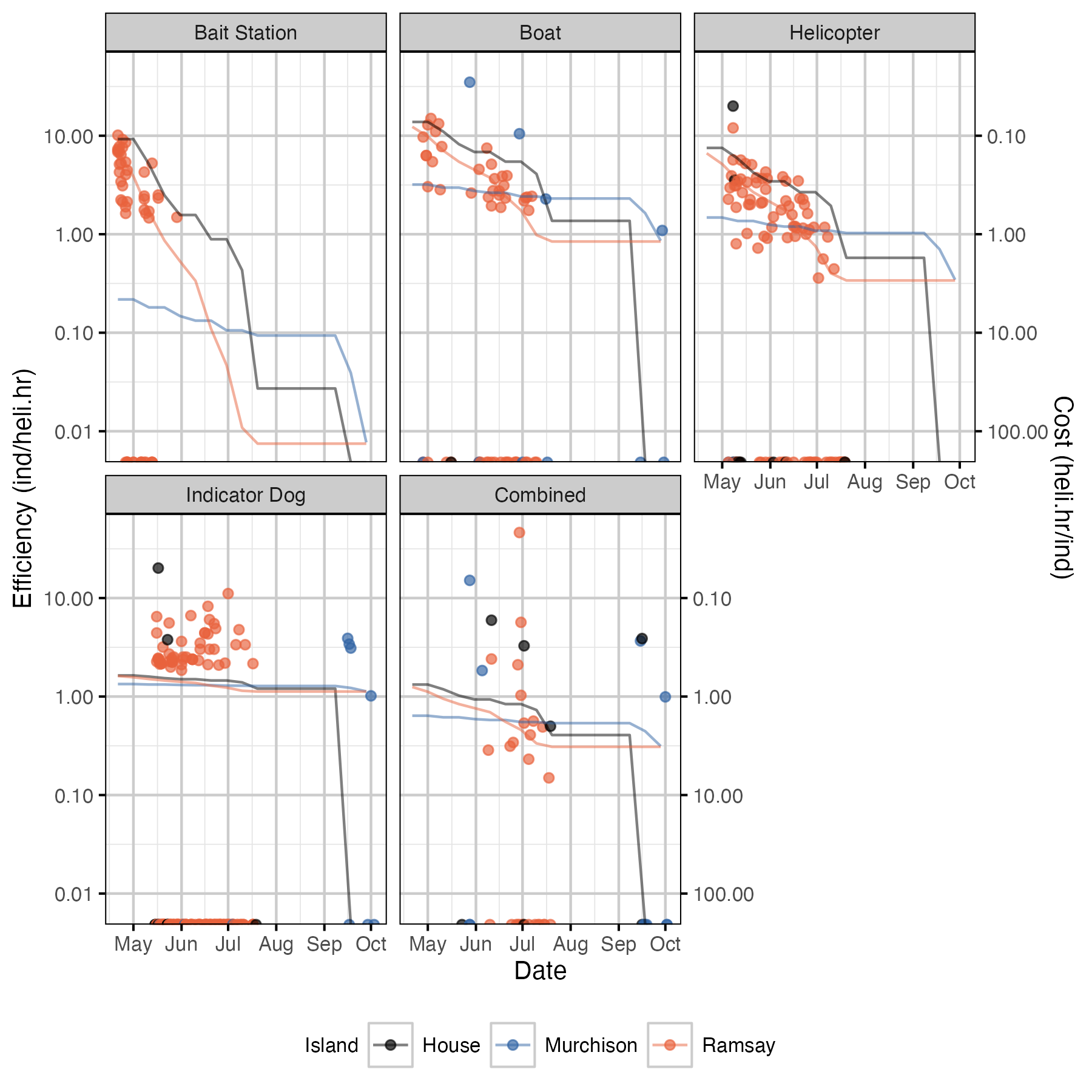
Figure 1. The removal efficiency by date, method and island with the estimated removal efficiency.
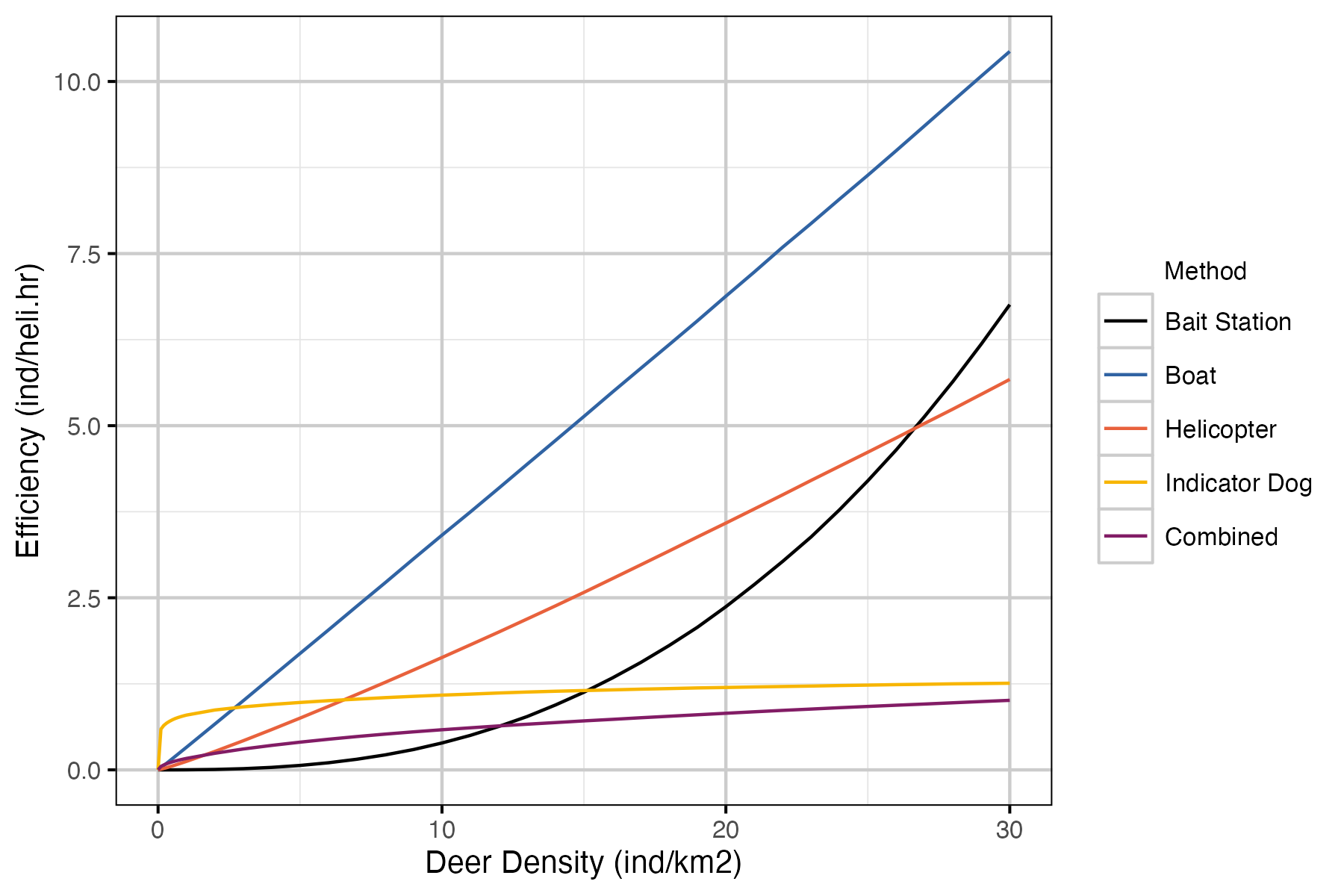
Figure 2. The estimated removal efficiency by density and method.
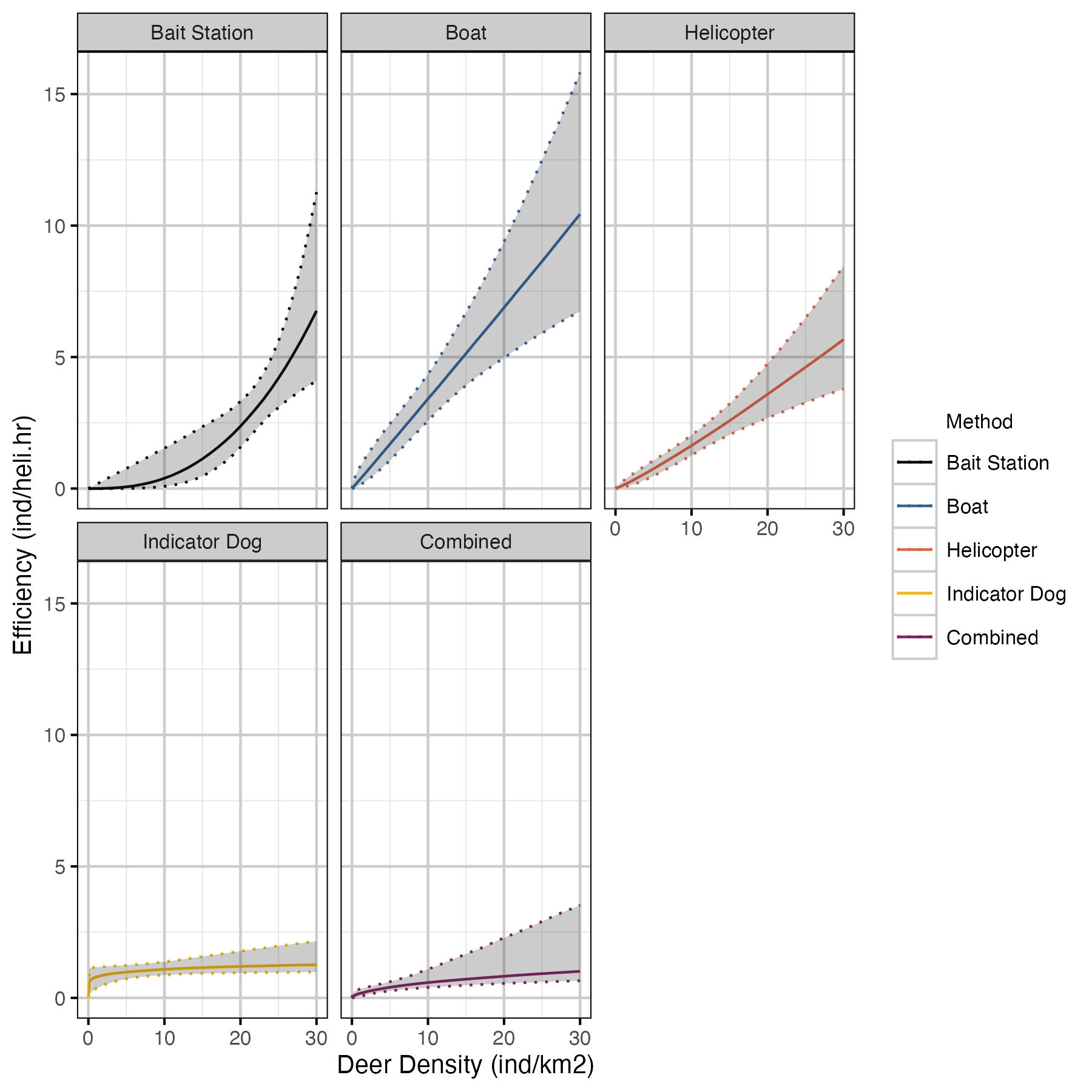
Figure 3. The estimated removal efficiency by method and density.
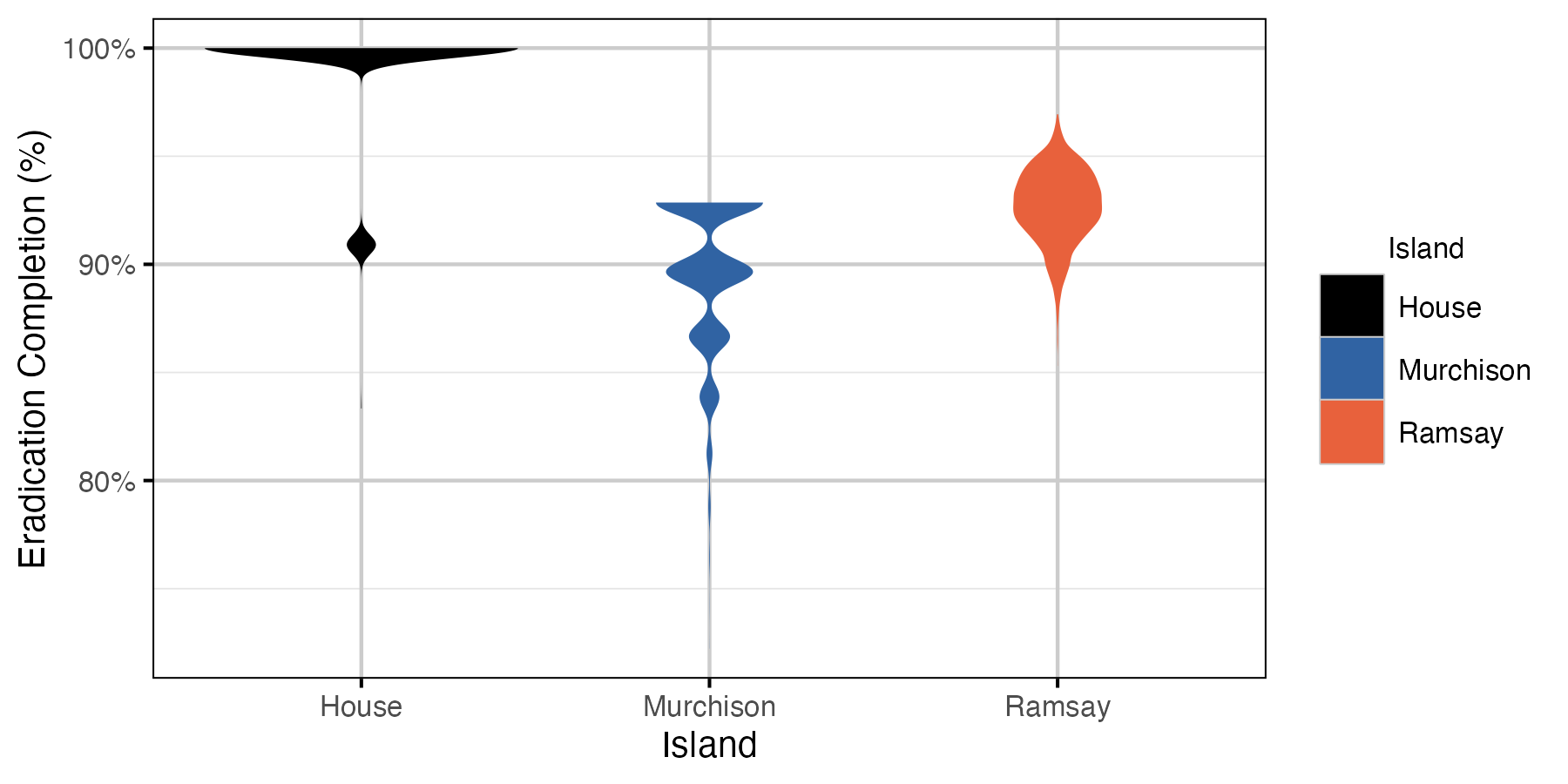
Figure 4. The posterior probability of the percent eradication completion by island.
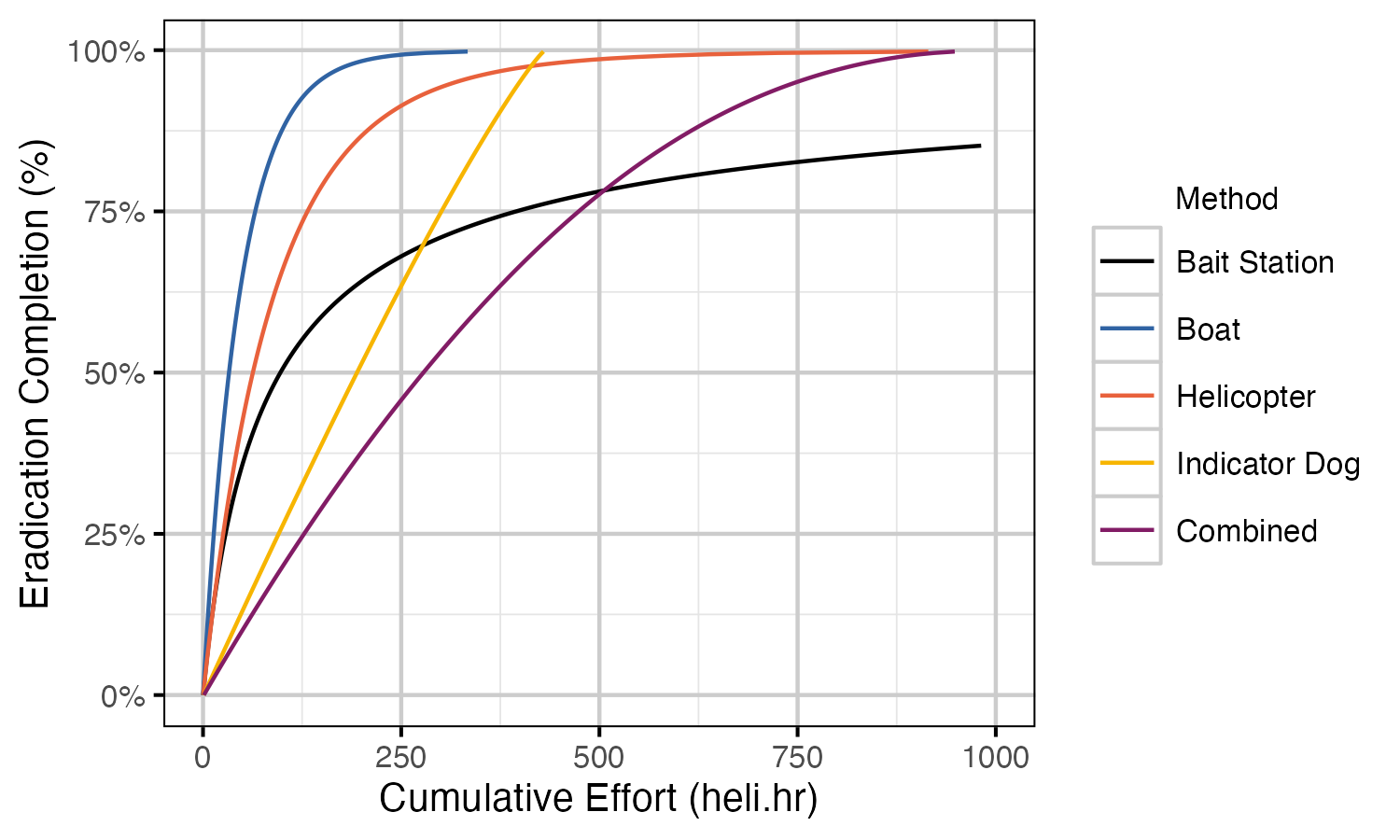
Figure 5. The estimated eradication completion by cumulative effort by method for Ramsay with a starting population of 466 deer.
Acknowledgements
The organisations and individuals whose contributions have made this analytic appendix possible include:
- Parks Canada
- Nadine Wilson
- Peter Dyment
- Charlotte Houston
- Patrick Bartier
- Christine Bentley
- Emily Gonzales
- Kent Prior
- Coastal Conservation
- Chris Gill
- Greg Howald
- Poisson Consulting
- Seb Dalgarno
- Simon Fraser University
- Carl Schwarz
- David Will
- Pete McLelland
- Norm MacDonald
- Gerry Morigeau